
Borr Drilling ($BORR)
The bull case is not that oil will go up massively, it is that nobody is building new rigs.

The thesis in short
Borr Drilling owns 29 modern jack-up rigs and 50% of a JV controlling another 5. It is one of the youngest premium shallow-water fleets in the world, serving customers all around the world, some of the main ones being Aramco, Shell, Eni, Petrobras, Pemex and QatarEnergy. A new rig of the same specifications would cost roughly $300m to build, and Borr has been buying working rigs from other operators at a quarter of that price. Nobody is ordering replacements, and the existing global fleet gets older every year. The five month, and counting, closure of the Strait of Hormuz is reminding every government on the planet that energy security is important, and shallow-water drilling is one of the fastest ways in the world to produce a barrel you control. Borr’s debt is fixed and long-dated. The value of its assets is not.
At a share price of ~$4 the market is valuing each rig at approximately $115m, for rigs that cost $300m to replace.
The assets
A jack-up is a platform with legs. It floats to its designated location, jacks itself up above the water, and drills at depths of up to about 120 meters. These rigs work in shallow water, drilling short wells near existing infrastructure, into reservoirs that are usually already understood.
The age of Borr’s fleet averages out to about 7 years. By contrast, the global fleet it competes against is one where a third of the rigs are over thirty years old. Those rigs cannot keep working forever, they will hit a recertification window and the owners will likely decide to scrap them.
Borr has mostly the same types of rig design, mainly JU-2000E, CJ50, JU-3000N and Super 116-C. This comes with the advantage that they use the same spare parts, the crews are trained the same way, and the procedures are uniform across the fleet. In a business where the customer buys uptime, that is worth quite a lot of money.
Lastly, it is a fleet of premium rigs, so customers usually pick these first, and at the top of the dayrate range.
No newbuilds
This is a main component of the thesis, and it is largely removed from the fluctuations in the price of oil.
A premium jack-up costs somewhere in the vicinity of $300m to build today. To justify signing a newbuild contract, a driller would need long-dated work at high dayrates — something that doesn’t exist in today’s environment. So nobody orders, and the existing fleet keeps shrinking by attrition.
Let me take a look at what Borr has been paying, compared to what the assets cost to build.
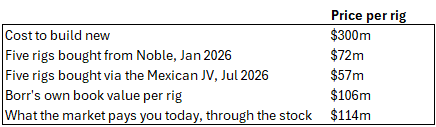
This is a structural mispricing that exists because offshore drilling has spent a decade destroying capital, and the market has not adjusted for the fact that the cure for low rates is low rates. Modern high-spec jack-ups are running near 94% utilization globally. There is not much slack left, and no meaningful newbuild supply arriving in the near term.
Hormuz has changed the question
The Strait of Hormuz has been effectively closed since the end of February, reopening briefly in June, only to be closed again shortly after. As of early August it is still running at a fraction of normal traffic.
Roughly a fifth of global oil consumption normally moves through Hormuz, and the IEA has called it the largest supply disruption in the history of the oil market.
The oil price has been the center of all the attention, but the lasting consequences are different and better. It has become apparent to every energy importer and every non-Gulf producer that a large amount of their supply runs through a waterway 33 kilometers wide that a single country can shut at will.
Jack-up rigs are the fastest answer to the problem at hand.
You can contract a rig, drill a handful of wells near existing infrastructure, and begin producing, all within the span of months rather than years. A deepwater project often takes four to seven years from being sanctioned to first oil. LNG, nuclear and new refining take even longer. If a government decides today that it wants incremental barrels under its own control, the shallow-water jack-up is the tool that delivers inside a standard political cycle.
This is why I think demand for jack-ups will become much stronger than the consensus assumes. The bull case does not require an oil price north of $100. It requires people to remain nervous, and right now that seems like a safe assumption.
The geography points at Borr
The intuitive read is that Aramco rushes to contract rigs once the situation normalizes. That will happen eventually, but there is a better version of the argument, which is especially favorable to Borr.
A closed Hormuz is an export problem, not a production problem. Producers behind the strait don’t lack barrels, they lack the ways to ship them. Saudi Arabia responded to the closure by pushing more than 70% of its crude through the East–West pipeline to Yanbu, lifting Red Sea volumes to around 4mb/d from under a million a year earlier.
This means that the energy-security bid does not go to the Gulf first. It goes to everywhere that is not behind a chokepoint: mainly Mexico, Brazil, Guyana, West Africa, Southeast Asia and the North Sea. Which is exactly where most of Borr’s rigs are located, so their fleet is already in the markets the world is about to prioritize.
The Saudi vacuum is reversing
The jack-up market did not collapse in 2024–25 because demand went down. It collapsed because Saudi Arabia changed its mind. Aramco had grown its working jack-up fleet from the mid-50s in 2022 to nearly 90 rigs by early 2024, then reversed and suspended 36 rigs.
Those rigs didn’t just disappear. They were redeployed into the aforementioned markets where Borr operates, and global dayrates fell by roughly 17%. Borr’s problem for the last two years has not been weak demand in its own markets, it has been the thirty-odd orphaned Saudi rigs undercutting it everywhere it went.
That issue is now unwinding, as Aramco has been issuing resumption notices: Shelf Drilling’s Harvey H. Ward back to work with a contract now running to October 2029, an ADES unit recalled from its Cameroon campaign, and two Arabian Drilling rigs restarting at prevailing market rates. Westwood’s read has been that Aramco could take back six to nine more idle rigs from early 2026.
Every rig that is absorbed by Aramco is a rig that stops bidding against Borr in other markets, which means Borr doesn’t need to win a single Saudi contract to benefit from it. It only needs the vacuum to close, and energy security concerns to push Aramco back toward its 90-rig ambition.
How much money can Borr earn?
You can build a lot of advanced financial models, but the simple stuff is often closer to correct. I can approximate EBITDA at different dayrates and utilization rates with a simple formula: Working rigs × 365 × utilization × (dayrate − daily opex), minus roughly $120m of annual overhead.
To get from EBITDA down to free cash flow, you then subtract about $200m of annual interest payments, $110m of maintenance and survey costs, and $35–40m of cash tax, $350m in total.
Borr currently has five idle rigs. Contracting them requires no capital, no construction and no permission. That recontacting alone can contribute significantly to EBITDA. Using these calculations (and assumptions) I can create a matrix showing EBITDA at different rig utilizations and dayrates.
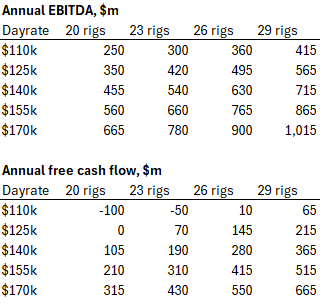
Borr currently sits around $137k on covered days with 71% of 2026 contracted, which is enough for the company to fund itself. If you assume the market improves to $155k across 26 rigs, which is not a crazy assumption, you get to $765m of EBITDA and $415m of free cash flow, against a company with a market cap of around $1.2bn. That is the entire investment case: the fleet is great and functioning, the rates are set by a tightening market, and no new supply is coming online.
The debt situation
Borr sits at around $2.3bn of net debt against a market cap of $1.2bn, which doesn’t sound amazing on paper. That is exactly why the opportunity exists.
In an upcycle the debt is fixed, while the value of the fleet is not. As dayrates and rig values re-rate toward replacement cost, the liability does not move with them, meaning essentially all of the increase accrues to the equity. Free cash flow does the same thing, transferring value from creditors to shareholders every quarter, with no re-rating required. Nothing has to get more expensive. The debt just has to get smaller.
Taking these assumptions and extrapolating three years out, I get the following scenarios:
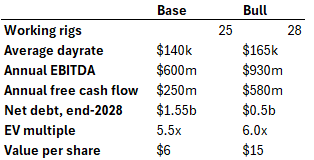
Looking at the bull column, EBITDA roughly triples from where it is currently, and the equity moves up by 4x. This is because $1.7bn of cumulative cash flow has moved off the debt line and onto yours. That is leverage working the way it is supposed to work, and it is the reason a cyclical bought correctly returns more than the cycle itself.
The refinancing bought the time to be right
The most important thing Borr did this year was not buying rigs. It was moving its maturity wall. It did this by issuing $1.10bn of 8.75% secured notes due 2032 and $935m of 9.00% notes due 2034, retiring 10.0% notes due 2028 and 10.375% notes due 2030. Separately, $300m of 3.5% convertibles due 2033 replaced 5% convertibles due 2028, with the conversion price lifted to $8.
The result is that the 2028–30 wall is gone, the coupon dropped by more than a point, and the old $144m of annual amortization went away.
For a cyclical whose recovery lands in 2027–28, six years of runway should be more than enough time. Borr now gets to be early without being punished for it, and that gives me a lot of security as I approach the turn of the cycle.
The people buying it
Tor Olav Trøim has been taking down open-market tranches, mainly 500,000 shares and then 1.2 million, through spring and summer. Jeffrey Currie has bought as well.
Trøim has been right about offshore cycles more than once, and he is buying with his own money at prices near where the stock trades today. When the people with the best information about the order book, the tenders and the customer conversations are buying the stock rather than selling it, it is worth registering.
What could make it fail
The recovery is a forecast. Every quarter it slips costs roughly $200m of interest. The refinancing means being early is survivable, but not free.
There is concentrated counterparty exposure in a country (Mexico) with a documented history of paying late, now partly inside a 50/50 JV where Borr controls less.
If the strait reopens and procurement goes straight back to buying the cheapest barrel, the urgency evaporates before it reaches a tender document. The structural case survives, the fleet still ages and newbuilds still don’t get ordered, but the re-rating slides right.
Further equity issuance. Borr suspended its dividend in 2025 and sold 21m shares at $4.00. Another raise at a depressed price would tell me management prefers funding the recovery with shareholders’ money rather than the cycle’s cash flow.
And the arithmetic cuts both ways: at 21 rigs and $120k dayrates, the enterprise value does not comfortably cover the debt.
Closing thoughts
Borr Drilling is offering you the youngest premium jack-up fleet in the world at roughly a third of the newbuild price, at a point in the cycle where the supply that broke the market is being withdrawn, and where demand looks to be increasing on the back of a geopolitical event that has not yet been resolved.
The maturities are far out in the future, and in the base case the cash flow is more than enough to service the debt and steadily reduce it. The base and bull cases are just for illustrative purposes, but what happens if the market gets much higher dayrates with every rig contracted?
